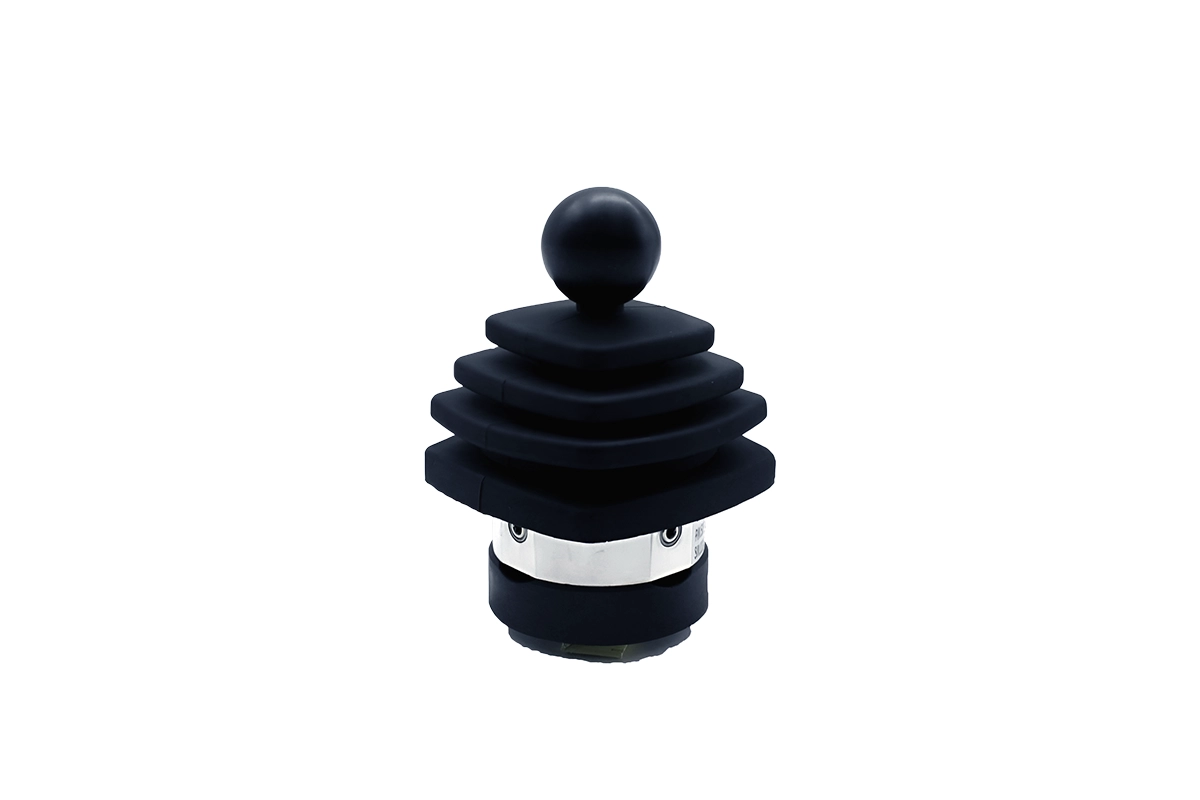

Discover why CANbus joysticks outperform traditional controls in reliability, real-time communication & wiring simplicity. Ideal for heavy-duty applications like construction and agriculture
CANBUS Joystick Introduction
CANBus Joysticks are revolutionizing control systems in industrial and mobile equipment. By leveraging Controller Area Network (CAN) technology, these joysticks deliver:
✅ Real-time communication (up to 1 Mbps)
✅ 50% fewer wires vs. analog joysticks
✅ Failure-resistant operation in harsh environments
From autonomous forklifts to excavators, CAN bus joysticks are the preferred choice for precision, scalability, and cost efficiency.
CANBUS Joystick Technology: How It Works
CANBUS is a serial communication protocol originally developed for automotive systems. Its two-wire design (CANH/CANL) enables:
- Bit rates: 10 Kbps to 1 Mbps
- Range: Up to 40 meters without signal loss
- Error detection: Automatic retransmission of corrupted data
Key Components:
- Physical Layer: Differential wiring for noise immunity.
- Data Link Layer: Prioritizes critical messages (e.g., emergency stops).
- Application Layer: Standardizes commands for plug-and-play compatibility.
CANBUS Joystick’s Protocols: J1939 vs. CANopen
| Feature | J1939 | CANopen |
|---|---|---|
| Industry Use | Heavy equipment (trucks, excavators) | Factory automation |
| Speed | 250 Kbps | 1 Mbps |
| Key Advantage | Standardized for OEMs | Flexible device integration |
Pro Tip: Use J1939 for off-highway vehicles, CANopen for robotic arms.
Top 5 CANBUS Joystick Benefits
1. Real-Time Communication
- Instant response (<10ms latency) for safety-critical tasks.
- Applications:
- 🚜 Autonomous tractors (precise steering control)
- 🏗️ Crane load management (overload prevention)
2. Reduced Wiring Complexity
- A single bus line replaces dozens of analog wires.
- Cost savings: 30% lower installation time vs. potentiometer joysticks.
3. Failure Resistance
- Even if one node fails, others operate normally.
- Self-diagnosis: Alerts for shorts, breaks, or EMI interference.
4. Scalability
- Add sensors/actuators without rewiring.
- Example: Upgrade a forklift with collision detection seamlessly.
5. Harsh Environment Durability
- Withstands:
- 🌡️ -40°C to +85°C temperatures
- 💧 IP67 waterproof ratings
CANBUS Joysticks vs. Traditional Joysticks
| Factor | CANBUS Joysticks | Potentiometer Joysticks |
|---|---|---|
| Wiring | 2-wire CANBUS | 10+ point-to-point wires |
| Maintenance | Self-diagnosing | Manual calibration |
| Cost (TCO) | Lower long-term costs | Higher replacement frequency |
Case Study: A mining company reduced downtime by 22% after switching to CANBUS joysticks.
FAQs
Q: Are CANBUS joysticks more expensive?
A: Upfront costs are 10-20% higher, but TCO is lower due to:
- Fewer wiring failures
- No periodic recalibration
Q: Can I retrofit CANBUS joysticks to old equipment?
A: Yes! Many CANBUS-to-analog converters exist (e.g., Danfoss Plus+1).
Q: What’s the maximum node limit?
A: Typically 110 nodes per bus, but extendable with bridges.
Conclusion
CANBUS joysticks offer unmatched reliability, simplicity, and performance for mobile and industrial equipment. As automation grows, their scalability and real-time control will become even more critical.
Ready to upgrade? Contact our experts for a free consultation.